Welcome to St. Mary and St. Mercurius Coptic Orthodox Church!
Christ is in our midst! 
We are part of the ancient Coptic Orthodox Church, founded by St. Mark the Evangelist (Gospel writer) in Alexandria, continuing the same faith, worship, and life in Christ that has been handed down through the apostles for nearly 2,000 years.
Whether you are exploring Christianity for the first time, seeking a deeper spiritual home, have questions about faith, or simply feel drawn to something ancient and authentic — you are most welcome here.
No one is expected to know everything or be ‘perfect.’ Come as you are. Observe, experience the Divine Liturgy, listen to the hymns and feel the presence of Christ among His people. Our doors are open to all — newcomers, inquirers, visitors, and friends.
The parish priests and community would be honored to answer your questions and walk with you as you discover (or rediscover) the love of Jesus Christ.
Come and see. We look forward to meeting you at our next service.”
What is the Coptic Orthodox Faith?
 Christianity in Egypt, as preached by the Apostle Mark (Gospel writer) in A.D. 43.
What is the Divine Liturgy?
The word liturgy means “the work of the people” and is the original form of the ancient Christian worship. The liturgy includes prayers, hymns (Coptic, Greek, English, Arabic), readings from the scripture, sermon, worship, and finally receiving the Holy Communion, the true Body and Blood of our Lord Jesus Christ.
Long hymns in Worship
In the Orthodox Church, long hymns aren't about length for its own sake, they're about depth. They help us slow down and enter into the mystery of God's presence. Just like the Psalms or the heavenly worship described in Revelation, our hymns are rich with Scripture and theology. They’re not rushed because love isn’t rushed. When we sing these hymns, we’re not just performing, we're praying, meditating, and joining the eternal praise of heaven. It's a spiritual journey, not a performance.
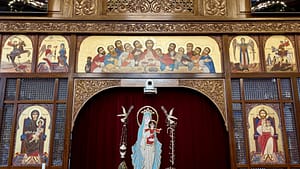
Icons and Pictures in the Church
Galatians 3:1 “O foolish Galatians! Who has bewitched you that you should not obey the truth, before whose eyes Jesus Christ was clearly portrayed among you as crucified?”
The Greek word for “portrayed” (proegraphē) literally means “publicly displayed or vividly depicted,” often used to describe something written or drawn out clearly.
God Himself ordered to decorate His house with paintings and drawings
1 Kings 6:29–35, 2 Chronicles 3:7, 14, Exodus 25:18–20, Exodus 26:1. More about this is discussed in the catechism class on Saturday.
Where to stand?
You may notice that men and women stand on opposite sides of the church (Women on the right & men on the left). This is an ancient practice dating back to the early church.
How do I follow along?
There are overhead screens/monitors to help you follow the prayers or using the Coptic Reader app for Android/Apple users.
Common words used during service
Key-ryalison: Lord have mercy
Pantocrator: Almighty
Agios: Holy
Incense
Burned to represent prayers rising to God in heaven based on Revelation 8:3-4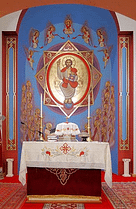
The Altar
A table inside the sanctuary where the bread and wine are kept for the entire service
(Hebrews 13:10 & 1 Corinthians 9:13)
Holy Kiss
Shortly after the sermon, the deacon will call everyone to “Greet one another with a Holy Kiss.” This is meant to fulfill Matthew 5:24. Before receiving the Holy Communion, we extend our hands to one another as a sign of peace.
• Romans 16:16: "Greet one another with a holy kiss."
• 1 Corinthians 16:20: "Greet one another with a holy kiss."
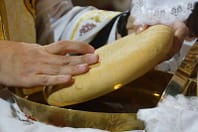
Holy Communion 
Near the end of the service, the priest will distribute the Holy Communion.
To participate in communion, you are required to be:
Historical Background
The Coptic Orthodox Church traces its origins to the 1st century AD, traditionally founded by Saint Mark the Evangelist (the author of the Gospel of Mark) in Alexandria, Egypt, around 43 AD. The term “Coptic” comes from the Greek “Aigyptos” (Egypt), via Arabic “Qibt,” originally referring to Egyptians and later specifically to Egyptian Christians. The church emphasizes its unbroken continuity with apostolic teaching and describes itself as preserving the “original faith” without deviation.
It played a major role in early Christianity in the Ecumenical Councils.
Core Beliefs
The Coptic Orthodox Church holds to foundational Christian doctrines shared with most other Christian traditions, while expressing some in its distinctive way:
The church is sacramental, recognizing seven sacraments: Baptism, Chrismation (Confirmation), Repentance/Confession, Eucharist (Holy Communion), Marriage, Priesthood (Holy Orders), and Unction of the Sick.
It is deeply traditional and liturgical, following the ancient Coptic Rite in worship, with strong emphasis on monasticism (Egypt is considered the birthplace of Christian monasticism), fasting, prayer, and the teachings of the early Church Fathers.
Distinctive Christological Position: Miaphysitism
The most notable theological distinction is its Miaphysite Christology (from Greek "mia physis" = "one nature out of two").
In summary, the Coptic Orthodox Faith is an ancient, apostolic, Trinitarian, and sacramental expression of Christianity that has faithfully preserved its traditions for nearly 2,000 years, with a strong emphasis on the mystery of the Incarnation as understood through Miaphysite theology. It remains the largest Christian community in the Middle East and has vibrant diaspora communities worldwide.
Coptic Hymns in English App

Praising God through hymns lifts up our spirits and allows us to communicate with the One we love. Chanting transcends us in liturgical worship. This is a service to unite the Coptic Orthodox Church to pray in one voice and one spirit.
This service is a central hub for other deacons to contribute ideas and hymns in order to unify our church. The lyrics for these standardized English hymns are found on the Coptic Reader App.


Coptic Reader
It contains the official Diocese translation of all the prayer books of the Coptic Orthodox Church in English, Coptic, and Arabic. Coptic Reader has been specifically designed to harness the power of modern mobile computing technologies to deliver a seamless user experience. Thousands of pages from dozens of books have been compressed and included in Coptic Reader allowing effortless access to all the prayers of the Church.
If you have any questions, email us at iamnew@smandsm.org or call us at 201-954-1001. We’re happy to help!